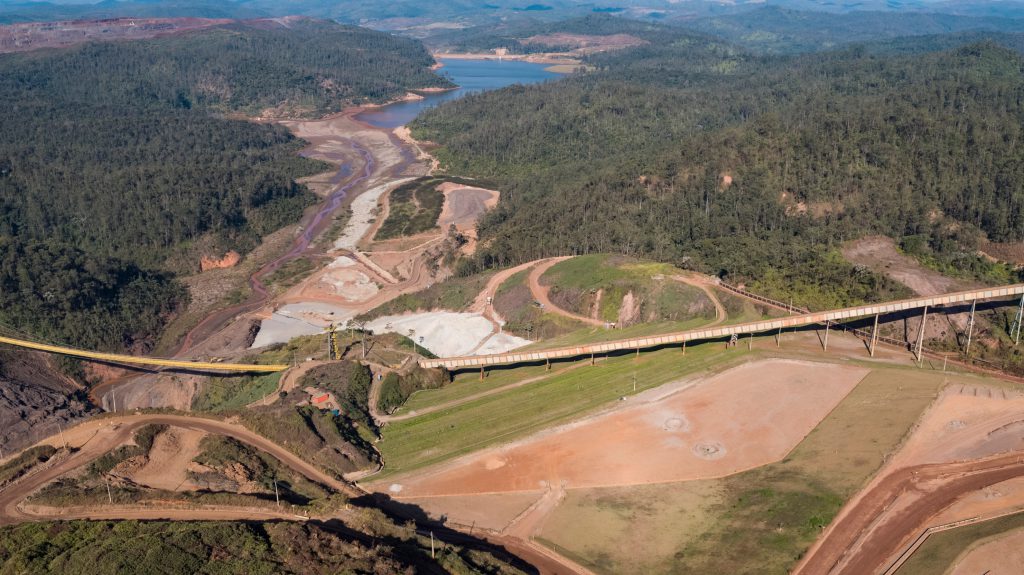
Reuse in Germano’s de-characterization drives the innovation agenda, while marketed waste rock and slimes incorporated into the concentrate increase efficiency and reduce impacts.
Samarco has been expanding the use of tailings and waste rock in its operations and engineering works, consolidating circularity as a strategic axis of the mining it intends to practice in the coming years. The main advancement lies in the reuse of sandy tailings in the de-characterization works of upstream raised structures at the Germano Complex, in Mariana (MG). However, other applications, such as the sale of part of the generated waste rock as ore and the incorporation of a concentrate derived from ultra-fine tailings, also demonstrate how the company is investing in economic circularity, reducing costs and environmental impact.
Since the company's operational restart in 2020 until December of last year, approximately 22 million metric tons had already been incorporated into interventions, equivalent to 61% of all sandy tailings generated in the period. The reuse rate of the generated sandy tailings reached 89% in 2025 alone.
The material, produced after the Filtration System, presents suitable geotechnical characteristics for grading (longitudinal profile of an area, indicating terrain slope and elevation), structural reinforcement, and drainage improvement—steps considered essential for the safe progress of de-characterization. The practice reduces the need for sand and crushed stone, decreases truck traffic, and contributes to lower emissions, in addition to extending the lifespan of existing disposal structures.
According to Samarco's Development and Innovation Manager, Bruno Pimentel, the potential for sandy tailings use goes beyond de-characterization works. Samarco is developing applications in concrete and ecological paving, such as that used on the Estrada da Purificação, in Antônio Pereira, a district of Ouro Preto. “Part of the blocks used in the project contained 33% reused tailings,” he states. He further highlights that Samarco is researching uses for ultra-fine tailings, which could enhance the efficiency of processing plants and reduce tailings generation in the long term.
Circular economy
For Innovation Specialist Marcos Gomes Vieira, this progress is part of a broader strategy. “In 2025, Samarco reached 45% total utilization of tailings and waste rock, the best index since operations resumed. The result reflects structural changes in material handling throughout the production chain,” explained Vieira.
Of the total utilized in 2025, 89% of sandy tailings were allocated to de-characterization works, 15% of the generated waste rock was sold as marginal ore — creating value for material previously without economic use — and 22% of the ultra-fine tailings that would have been
generated at Concentrator 3 were incorporated into the concentrate, increasing metallurgical recovery and reducing tailings generation.
These applications demonstrate that, at Samarco, circularity is a directive guiding engineering decisions and mine planning. This includes redesigning processes to reduce tailings at the source, reincorporating materials into the production flow, using tailings in infrastructure works, and the economic valorization of secondary materials.
Samarco has a robust strategic Sustainability program, with goals aligned with the International Council on Mining and Metals (ICMM), Ibram, and national climate guidelines. The advancements are aligned with the company’s sustainability strategy, which includes goals for tailings reduction, water and energy efficiency, technological innovation, and decarbonization, with a commitment to reduce Scope 1 and 2 emissions by 30% by 2032 and achieve carbon neutrality by 2050.
Long-term vision
For Samarco, the mining of the future will be more circular, technological, and integrated with the local communities and regions. Priorities include expanding technologies in the desliming stage, developing new applications for sandy tailings and waste rock, partnerships with research centers, and incorporating circularity from the engineering phase of projects.
Other tailings and waste rock utilization projects under development include the possibility of selling sand from tailings for civil construction, and the installation of magnetic concentrators after the desliming stage, which could generate about 900,000 metric tons of concentrate from ultra-fine tailings per year, incorporating them into the production process.
Bruno Pimentel emphasizes that the numbers from the last year show it is possible to reconcile production, safety, and sustainability with innovation and operational discipline. “The use of sandy tailings at Germano, the sale of waste rock as ore, and the generation of a concentrate from ultra-fine tailings are examples of a structural change in how materials, previously treated only as waste, are handled. And if we consider the projects and solutions currently under development, the scope of this new way of working with tailings will yield even better results,” he commented.