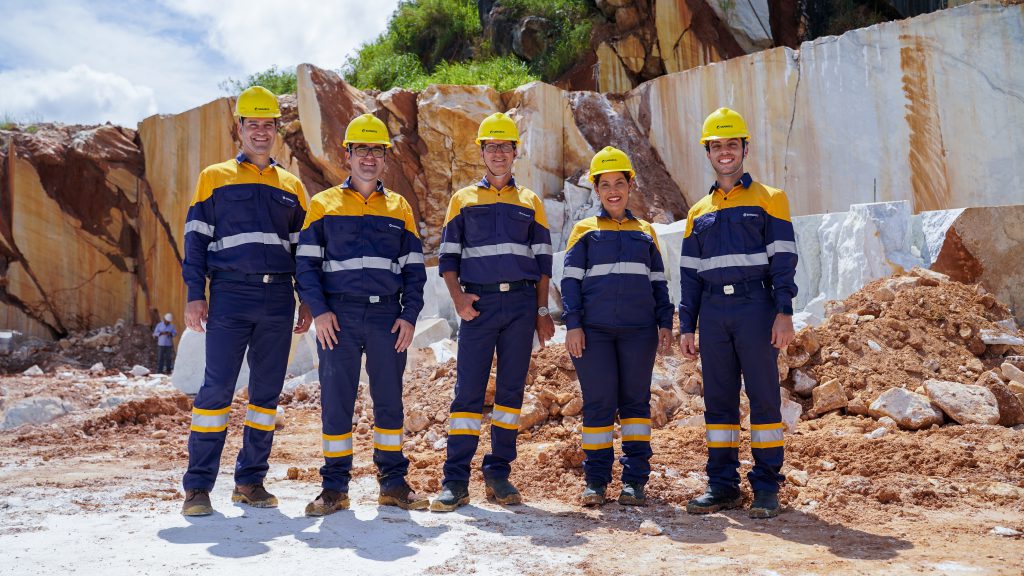
Samarco intends to implement the use of marble mining residues in the production of iron ore pellets, in addition to limestone. The practice makes the company a pioneer in an innovative sustainability action. The results of the studies that enabled the execution of the project were presented this Tuesday (07), in São Paulo, at ABM Week, an event provided by the Brazilian Association of Metallurgy, Materials and Mining (ABM).
The study to verify the feasibility of using waste as an input in pelletizing started in 2020. Since then, several tests have been carried out with positive results for the use of the marble by-product as an alternative input for the production of pellets.
During the presentation at ABM Week, the process engineer, Ana Maria Bailon, gave details about the studies. “In the industrial test, the marble waste have results that meet the monitored quality indices. The benefits are many, such as positive impacts on pellet quality and reduction of carbon dioxide emissions and fuel consumption, ensuring peace of mind to work with the input. But I particularly highlight the reduction of the environmental impact of the production of ornamental stones in the surrounding communities and, at the same time, transforming the waste from this process into a 100% sustainable input for pelletizing. Therefore, alternatives like this result in improvements for society, the environment and also for our customers”, she highlighted.
Espírito Santo is the largest producer of ornamental stones in the country, responsible for about 80% of production and Brazil is the fourth largest in the world. “We studied alternatives to use the waste from this sector, as only 20%, on average, of the production is used as a final product. This co-product generated is chemically and physically similar to the limestone consumed in one of our plants in the UBU Complex (ES), currently around 400 tons/day”, pointed out Samarco's process engineering coordinator, Felipe Morato.
Innovation and sustainability
In addition to the use of marble mining waste in pellets, other innovation and sustainability projects are being presented by Samarco during the ABM WEEK program.
Creator of the study on the possibility of using ornamental stone waste in the production of pellets, the Director of Planning and Operations, Sérgio Mileipe, proposed the challenge to the team in 2018. “We are innovating in a practice that consists of using an input in the production of pellets, which will significantly contribute to reducing the volume of waste. This is part of our new way of carry out mining, with a focus on sustainability. This project is an opportunity for us to practice our purpose of carrying out mining differently, safer and more sustainable, that generates results, but above all preserves the environment,” he said.
Last March, Samarco launched the Movement for Innovation, to reinforce the company's mobilization and advance its purpose of carrying out mining differently, more sustainable and safer. The movement is an important milestone for cultural evolution, considering that innovation is one of the cultural traits to be developed, being necessary to guarantee the company's longevity.