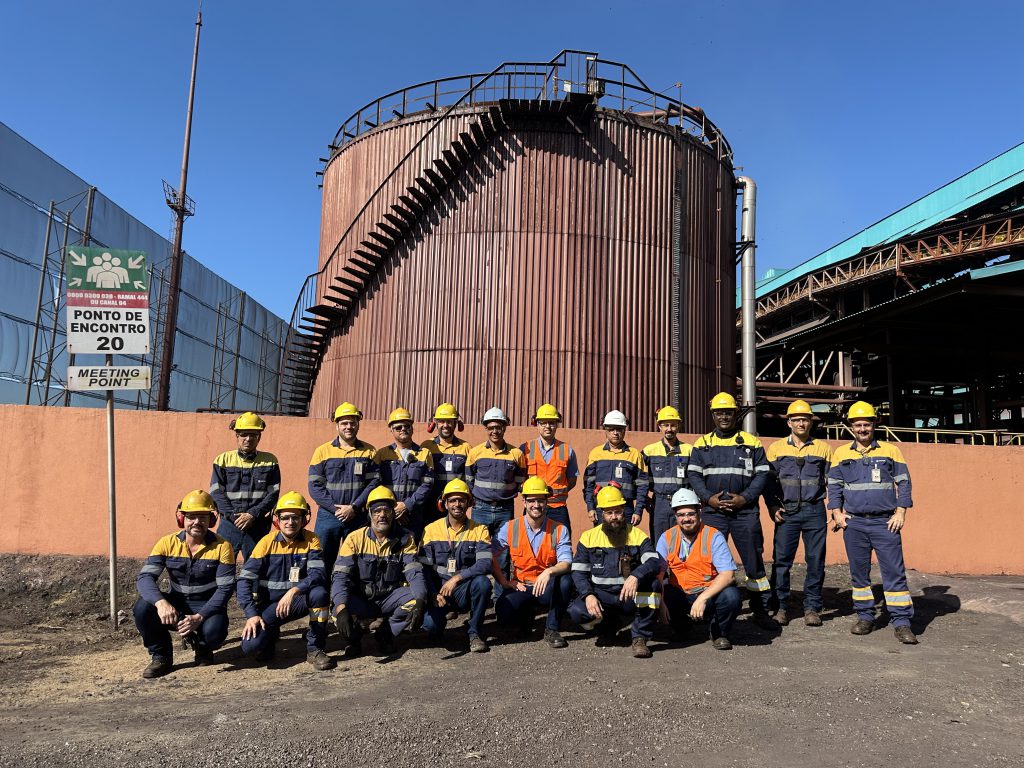
Samarco has entered into a partnership with Aperam Bioenergia, a subsidiary of Aperam South America, to use bio-oil in Pelletizing plants 3 and 4 at the Ubu Complex. The energy transition and decarbonization, with the gradual replacement of the energy matrix in the production processes, are aligned with Samarco's commitment to the circular economy and the reduction of the company's carbon footprint.
The tests, which took place in September, showed positive results, such as the maintenance of flame temperature, power, shape, viscosity and pressure.
Samarco expects to approve a sustainable alternative to natural gas, with the potential to reduce the company's scope 1 emissions by 2 kgCO2 per ton of dry ore (dry ore) in the short term. Considering that natural gas accounts for more than 20 kgCO2/tms of the 80 kgCO2/tms emitted, this change is an important milestone on the path to decarbonization.[Quebra da Disposição de Texto][Quebra da Disposição de Texto] “The project is a pioneer in this type of application and is aligned with the global goal of reducing greenhouse gas (GHG) emissions by 30% by 2032. This reflects our commitment to sustainable innovation initiatives. Sustainability is a commitment for all of us and, with bio-oil, we are transforming this vision into concrete action”, emphasizes Rodrigo Vilela, Samarco’s CEO.
Samarco team is overcoming operational challenges to adapt processes to the use of biofuel. Throughout 2024, the tests will consume a total of 220 tons of bio-oil at Plant 3, reducing CO2 emissions by 300,000 kg. With the continuity of the project, this reduction could reach 18,000 tons per year.
Sérgio Mileipe, chief operating officer, states that the tests focused on the applicability of bio-oil in Samarco's production process are meeting expectations and are essential for the positive results achieved to date. "The good performance of the biofuel demonstrates the technical feasibility for the continuous replacement of the natural gas used. In addition to greater efficiency and operational safety, the use of bio-oil reinforces our sustainable commitment to communities", he explains.
Bio-oil comes from plant sources, is 100% renewable, produced during the transformation of eucalyptus wood into charcoal, contributing to driving the transition of industries towards a renewable and low-carbon energy matrix, capable of replacing fossil fuels in industrial processes.
Frederico Ayres Lima, chairman of Aperam South America, explains that bio-oil is part of Aperam's broader strategy to expand its area of operations beyond steel production, increasingly integrating itself into the circular economy model with the development of solutions and co-products from its planted forests in the Vale do Jequitinhonha.
“In addition to coal production, we were able to add bio-oil production through the development and implementation of our own technology in our processes. Over the years, Aperam BioEnergia has enabled the production of a biogenic fuel with great potential, with zero CO2 emissions in its use and which has helped our partners to decarbonize their processes,” says the chairman of Aperam.
The COO of Aperam BioEnergia, Ézio Santos, stated that the validation of the product's application reinforces, both commercially and environmentally, the sustainability of the large-scale use of bio-oil produced by Aperam BioEnergia. “These results show that we are on the right track, offering the market a 100% national product, with high added value and that contributes to the decarbonization of industrial processes”, he highlighted.
About Aperam BioEnergia
Carbon neutral in scopes 1 and 2 for four consecutive years, Aperam South America is an integrated producer of stainless, electrical and carbon steels, consolidating its leadership in the Brazilian market in its segment. Its industrial plant, located in Timóteo (MG), has a total production capacity of 900,000 tons of liquid steel per year and is entirely powered by charcoal produced at Aperam BioEnergia in Vale do Jequitinhonha, a renewable fuel that replaces coke, a highly polluting reducer still widely used by the industry. Aperam BioEnergia, a renewable energy producer, currently offers the market bio-oil, seedlings, charcoal, technology and more.
Learn more about bio-oil: https://vimeo.com/manage/videos/1019859582/c09e91658c
Photos: Aperam Archive/Samarco Archive